The RFP Maturity Ladder: Which Rung Is Your Organization Actually On?
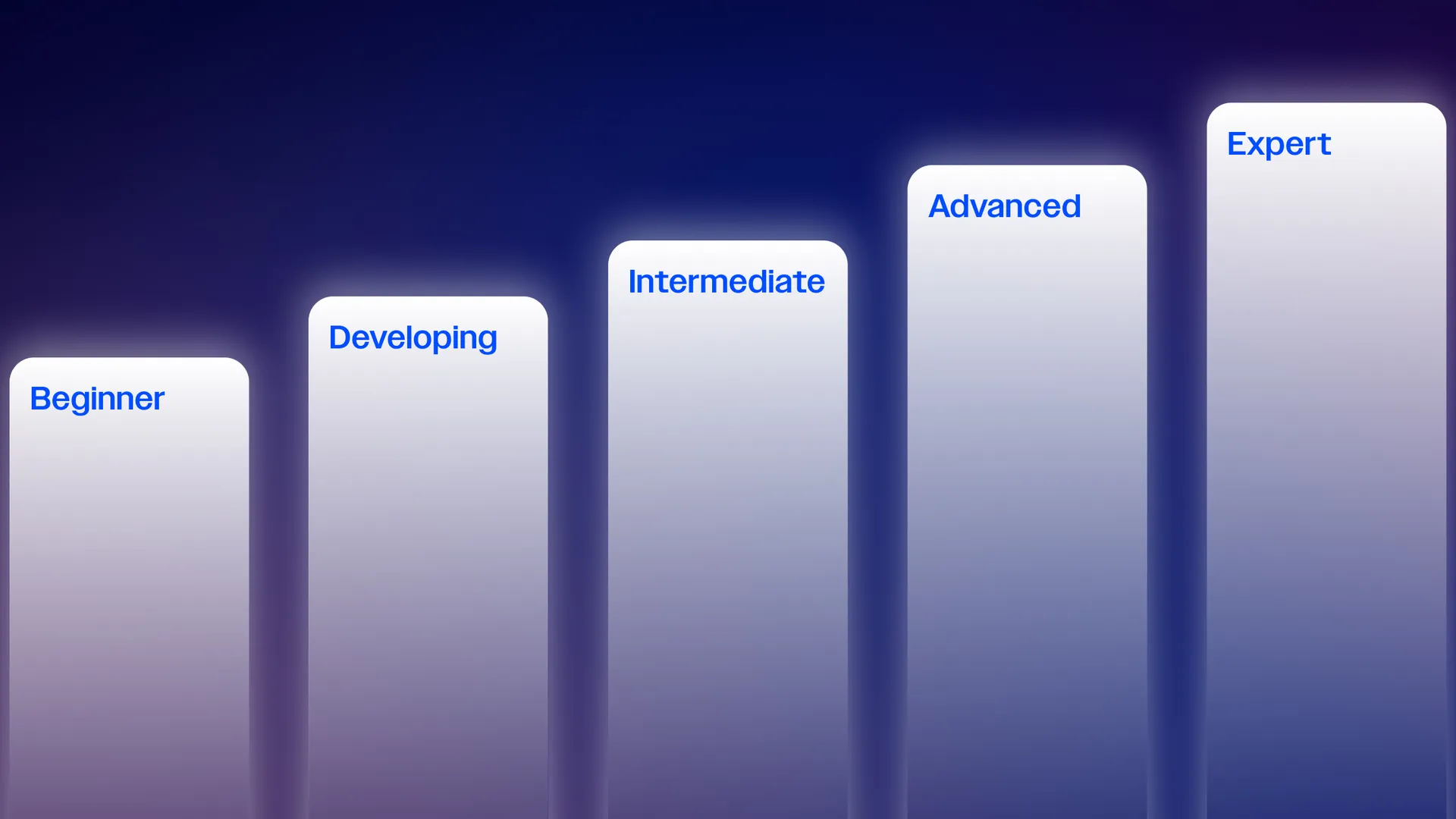
If you ask ten companies how mature their RFP process is, most will describe it in relative terms – “better than it used to be,” “still pretty chaotic,” “we’ve got a system, sort of.” Few can point to where they actually sit on any kind of defined scale, because most organizations have never mapped one out. That’s a missed opportunity, because RFP capability tends to develop in fairly predictable stages, and knowing which stage you’re actually in – as opposed to which stage you’d like to believe you’re in – is the single most useful diagnostic for figuring out what to fix next.
This matters because the fixes that help a company move from stage one to stage two are often completely different from the fixes that help a company move from stage three to stage four. A team stuck in early-stage chaos doesn’t need sophisticated analytics; it needs basic organization. A team that already has solid organization but is struggling to scale doesn’t need another spreadsheet template; it needs infrastructure. Applying the wrong fix for your actual stage wastes time and, worse, can make leadership skeptical of future investment when the “obvious” solution doesn’t produce the expected results.
Stage One: Reactive Chaos
This is where most organizations start, and a surprising number of otherwise sophisticated companies never fully leave it. RFPs arrive unpredictably and get handled by whoever happens to be available, using whatever templates they can find, with no consistent process for review or approval. There’s no central repository of past answers – institutional knowledge lives in individual people’s heads and personal folders. Deadlines get met through heroic last-minute effort rather than reliable process, and quality varies enormously depending on who happened to catch a given deal.
The telltale signs of stage one are unmistakable: proposal work consistently happens under crisis conditions, the same questions get answered from scratch repeatedly because nobody can find the last answer, and the departure of any single experienced team member creates a visible capability gap because so much knowledge was never captured anywhere durable.
Organizations at this stage don’t need sophisticated tooling yet – they need basic organizational discipline. The highest-leverage fix is simply consolidating existing proposal content into one accessible, searchable place, even if that place is initially just a well-organized shared drive with a clear folder structure and naming convention. This sounds almost too basic to mention, but it’s the single most commonly skipped step, because teams in crisis mode rarely feel like they have the bandwidth to pause and organize – even though that pause would save far more time than it costs.
Stage Two: Organized but Manual
At this stage, a company has done the basic organizational work – there’s a real content library, some documented process for how RFPs move from intake to submission, and probably a designated owner for proposal work rather than an ad hoc volunteer. This is real progress, and it noticeably reduces the chaos of stage one. But everything still runs on manual effort: searching the library by hand, manually assembling drafts, routing questions to subject matter experts through email or Slack, and tracking status in a spreadsheet that someone has to remember to update.
The limitation of stage two isn’t quality – teams here often produce genuinely strong, well-organized proposals. The limitation is scale. Manual processes that work fine at ten RFPs a quarter start to strain at thirty, and break down entirely at a hundred. Response times stay roughly constant per proposal even as volume grows, which means total capacity is fundamentally capped by headcount, and adding capacity means adding people rather than adding efficiency.
Organizations at this stage are the ones most likely to benefit immediately from automation and AI-assisted tooling, because the organizational groundwork – a real content library, a defined process – is already in place. Automation applied to genuine chaos, as noted in stage one, tends to underperform because there’s nothing solid to build on. Automation applied to stage-two organization tends to deliver real, immediate returns, because it’s accelerating a process that already works, rather than trying to compensate for one that doesn’t.
Stage Three: Automated and Consistent
Here, the manual bottlenecks of stage two have largely been addressed. AI-assisted drafting pulls from a centralized, well-maintained knowledge base. Routing and status tracking happen through a shared system rather than individual memory. Review cycles run in parallel rather than in a long sequential chain. Response times have dropped meaningfully, and – critically – they stay relatively stable even as RFP volume grows, because the process is no longer purely headcount-bound.
This stage feels, understandably, like the finish line to many organizations, and in fairness, it represents a genuinely mature capability that most companies never reach. But there’s a meaningful gap between stage three and true strategic maturity, and it shows up in a specific way: at stage three, the RFP function is efficient, but it’s still fundamentally reactive. It responds well to whatever comes in, but it isn’t yet using its own data to actively improve win rates, isn’t systematically learning from losses, and isn’t feeding insight back into sales strategy or product positioning.
Stage Four: Strategic and Data-Informed
At the most mature stage, the RFP function stops being purely a response mechanism and starts operating as a genuine intelligence source for the broader revenue organization. Teams here track not just turnaround time but win rate by proposal type, industry, and deal size. They systematically analyze losses to identify recurring patterns – a consistently weak answer in a particular category, a competitor who keeps winning on a specific dimension – and feed those insights back into both the proposal process and broader sales strategy. They know which sections of a proposal correlate most strongly with winning, and they allocate review effort accordingly rather than spreading attention evenly.
This stage also tends to feature genuine cross-functional integration: proposal insights inform product roadmap conversations when the same gap keeps showing up across multiple losses, and sales leadership treats RFP win-rate data as a real input into forecasting and territory strategy, not just an operational metric buried in a proposal team’s internal dashboard. Comprehensive <cite index=”0-1″> RFP management at this level functions less like a document production process and more like a strategic feedback loop, continuously turning the outcomes of past proposals into sharper positioning and better-informed decisions for future ones</cite>.
Diagnosing Your Own Stage Honestly
Most leaders overestimate where their organization actually sits on this ladder, for understandable reasons – the parts of the process that work well are more visible than the parts that don’t, and nobody wants to describe their own function as “chaotic.” A more honest diagnostic tends to focus on a few specific, hard-to-fudge questions:
Can a new team member find the right answer to a common question in under a minute, without asking a colleague? If the honest answer is no, you’re likely still in stage one, regardless of how organized things feel to people who’ve built up years of tribal knowledge about where things live.
Does response time per proposal stay roughly constant as volume grows, or does it degrade? Degrading response times under growing volume is the clearest signal of a stage-two ceiling – a process that works, but doesn’t scale.
Do you know your win rate by proposal category, and has that data influenced any actual process change in the last six months? If the answer is no, even a genuinely fast, well-automated process is likely still stuck at stage three, efficient but not yet strategic.
Moving Up a Rung, Not Skipping Ahead
The temptation, once a stage is honestly identified, is to try to jump straight to stage four – buying sophisticated analytics tools while the underlying content library is still disorganized, for example. This rarely works well, because each stage genuinely depends on the one before it. Sophisticated win-rate analytics are only meaningful once there’s a consistent, automated process generating clean data to analyze. Automation only delivers real value once there’s organized content for it to draw from.
The more reliable path is sequential: get organized before automating, automate before optimizing, and optimize before trying to turn the function into a strategic data source. Organizations exploring what mature RFP management actually looks like at each of these stages often find it useful to benchmark their current capability honestly against this kind of ladder before investing in new tooling, since the right next investment depends entirely on which rung they’re actually standing on.
The Takeaway
There’s no shortcut to RFP maturity, but there is a reliable sequence, and knowing where your organization genuinely sits on it – rather than where you’d like to believe you sit – is worth more than any individual tool or template. The companies that build lasting RFP capability aren’t the ones that jumped straight to sophisticated analytics or the flashiest automation tool. They’re the ones that honestly diagnosed their current stage, fixed the actual bottleneck holding them back, and moved up one deliberate rung at a time.