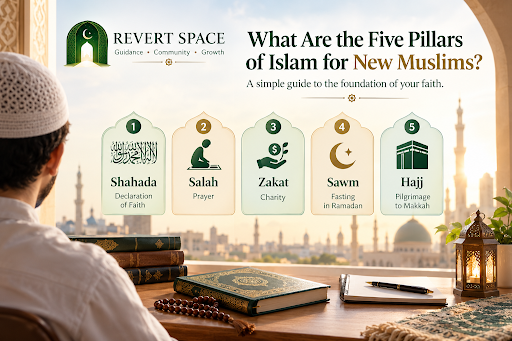
What Are the Five Pillars of Islam for New Muslims?
Every new journey needs a foundation, and in Islam that foundation is remarkably clear.
Five acts of worship hold up the whole structure of the faith, and each one is simple to understand.
If you are learning Islam as a new Muslim, this guide walks you through them in plain language, one pillar at a time.
No jargon, no pressure, and no need to master everything this week.
The Five Pillars at a Glance
The Five Pillars of Islam are the five core acts of worship every Muslim is asked to uphold: the declaration of faith, prayer, charity, fasting, and pilgrimage. The Prophet Muhammad (PBUH) described Islam as being built upon them.
- Shahada: declaring faith in one God and the Prophethood of Muhammad (PBUH)
- Salah: praying five times a day
- Zakat: giving a portion of your wealth to those in need
- Sawm: fasting during the month of Ramadan
- Hajj: pilgrimage to Makkah, once in a lifetime for those who are able
Think of them as the frame of a house. You do not need to furnish every room today, but you should know where the walls are. These Islamic basics shape everything else you will learn.
Pillar One: Shahada (Declaration of Faith)
The shahada is the statement that there is no god but Allah and that Muhammad (PBUH) is His messenger. Saying it sincerely is what makes a person Muslim.
What it means in daily life:
- Worship belongs to Allah alone
- Muhammad (PBUH) is the final messenger and your best example
- Faith is a living relationship, not a performance
If you want to take your shahada with a qualified Imam present, Revert Space offers a free virtual shahada service.
Pillar Two: Salah (Prayer)
Muslims pray five times a day: Fajr, Dhuhr, Asr, Maghrib, and Isha. Prayer is a direct conversation with Allah, and it keeps your day anchored around what matters most.
Beginner tips:
- Learn wudu (ritual washing) first
- Build up gradually, adding prayers as you gain confidence
- Memorize short surahs one at a time, starting with Al Fatiha
- Make personal du’a in any language, while the prayer recitation is in Arabic
Pillar Three: Zakat (Charity)
Zakat is an annual obligatory charity, generally 2.5 percent of qualifying savings. It applies to Muslims whose wealth stays above a minimum threshold, known as nisab, for a full lunar year. It purifies wealth and supports the community.
Key points:
- You do not owe zakat if your savings are below nisab
- The Qur’an names the categories who may receive it, including the poor and the needy
- Voluntary charity (sadaqa) is encouraged at any time, and even a smile counts
- Ask a trusted scholar to help you calculate it for your situation
Pillar Four: Sawm (Fasting in Ramadan)
Muslims fast from dawn to sunset during Ramadan, the ninth month of the Islamic calendar. That means no food, drink, or intimate relations during daylight hours, while growing in patience, gratitude, and Qur’an recitation.
Helpful notes:
- The sick, travelers, and pregnant or nursing women may be exempt, with makeup days or compensation as scholars advise
- Eat a pre dawn meal (suhoor) and break your fast (iftar) with dates and water
Pillar Five: Hajj (Pilgrimage)
Hajj is the pilgrimage to Makkah, performed during Dhul Hijjah, the twelfth month of the Islamic calendar. It is required once in a lifetime for Muslims who are physically and financially able. Millions of people from every nationality stand together in the same simple clothing, which is a powerful reminder of equality before Allah.
Many new Muslims are years away from Hajj, and that is completely fine.
Common Mistakes New Muslims Make
Watch out for these habits:
- Trying to do everything perfectly from day one
- Comparing yourself to people born into the faith
- Confusing cultural traditions with the pillars themselves
- Skipping Islamic basics to chase advanced debates
- Learning only from social media clips
Did You Know? The Five Pillars describe what a Muslim does. The six articles of faith, such as belief in the angels and the Last Day, describe what a Muslim believes. Together they give a complete picture and form the core of any solid new Muslim education.
Expert Insight: In my experience guiding new Muslim learners, the ones who thrive treat the pillars as habits built slowly, not a checklist to conquer. One pillar practiced consistently beats five practiced for a single week.
Pro Tip: Choose the pillar you feel least comfortable with and make it your focus for two weeks.
A Gentle Four Week Plan
Use this as a starting point and adjust it to your own pace:
- Week 1: Reflect on the meaning of the shahada and learn how to perform wudu
- Week 2: Learn the words and movements of prayer, beginning with Al Fatiha
- Week 3: Understand how zakat and sadaqa work and start a small giving habit
- Week 4: Read about Ramadan and Hajj, then bring your questions to a mentor
Conclusion: Take the Pillars One Step at a Time
The five pillars are not a test to pass. They are a framework that grows with you, starting with a sincere declaration and deepening through prayer, giving, fasting, and pilgrimage. Learn one piece at a time and be patient with yourself.
Revert Space exists to walk with you through that process, with free structured courses like Life After Shahada and Fiqh for Beginners, personal mentorship, and a community that never judges your questions. Visit Revert Space today and build your foundation with people who understand your journey.
Frequently Asked Questions
Do I have to practice all five pillars right away?
No. Begin with the shahada and prayer, then add the others gradually as you learn and your circumstances allow.
What is the difference between the pillars and the articles of faith?
The pillars are acts of worship. The articles of faith are core beliefs, such as belief in Allah, His angels, His books, and the Day of Judgment.
Is zakat required if I have very little money?
Zakat is only due when your savings stay above the nisab threshold for a lunar year. If you are unsure, ask a qualified scholar.
Can I still fast if this is my first Ramadan?
Yes, and it is encouraged. Take it day by day, and speak with a mentor if you have health concerns.
Where can I learn the pillars step by step?
A structured beginner course with a mentor works best. Choose teachers who cite the Qur’an and authentic hadith.