Advanced Indoor Humidity Buffering Materials for Stabilizing Moisture Levels in Naturally Ventilated Homes
A naturally ventilated home breathes with the weather, and its indoor humidity swings with it. Cooking, showering, and drying laundry push moisture into the air, while a cold night or an open window pulls it away again, and the result is a daily cycle of damp peaks and dry troughs that can leave windows streaming, paint peeling, and noses stuffy by morning. Advanced indoor humidity buffering materials change that by absorbing moisture when the air is damp and releasing it when the air dries, smoothing the peaks without a machine. The short answer is that hygroscopic surfaces such as clay plaster, lime plaster, and untreated wood act as a passive moisture battery for the room, and in a home ventilated at less than about one air change per hour they can steady indoor humidity noticeably, with no energy use and no maintenance beyond normal care.
Why Indoor Humidity Swings So Much in Naturally Ventilated Homes
A household generates a surprising amount of moisture every day. Cooking, showering, washing, and simply breathing add litres of water vapour to the indoor air, and in a naturally ventilated home that moisture leaves only when a window opens or air leaks through the building fabric. The result is a daily rhythm: humidity climbs through the evening as the family cooks and showers, peaks overnight when the house is closed up, and falls during the day when windows open and the sun warms the rooms. In winter the swings are sharper, because cold outdoor air holds little moisture and warm indoor air holds a great deal, so a small change in ventilation makes a large change in relative humidity.
Which Materials Buffer Humidity Best
Not all building materials buffer humidity. Most modern finishes, such as vinyl paint, plastic wall coverings, and sealed tiles, are vapour-closed and contribute almost nothing, because moisture cannot reach the material beneath them. The best buffers are porous, hygroscopic materials with a large internal surface and a good vapour permeability: unfired clay brick and clay plaster, lime plaster, wood cut across the grain, wood fibre boards, and cellular concrete. Research comparing plasters in laboratory and full-scale room tests has consistently found clay plaster among the strongest performers, with lime and gypsum behind it, and the difference comes down to how much water the material can adsorb and release within a daily cycle.
Clay Plaster: The Benchmark Buffer
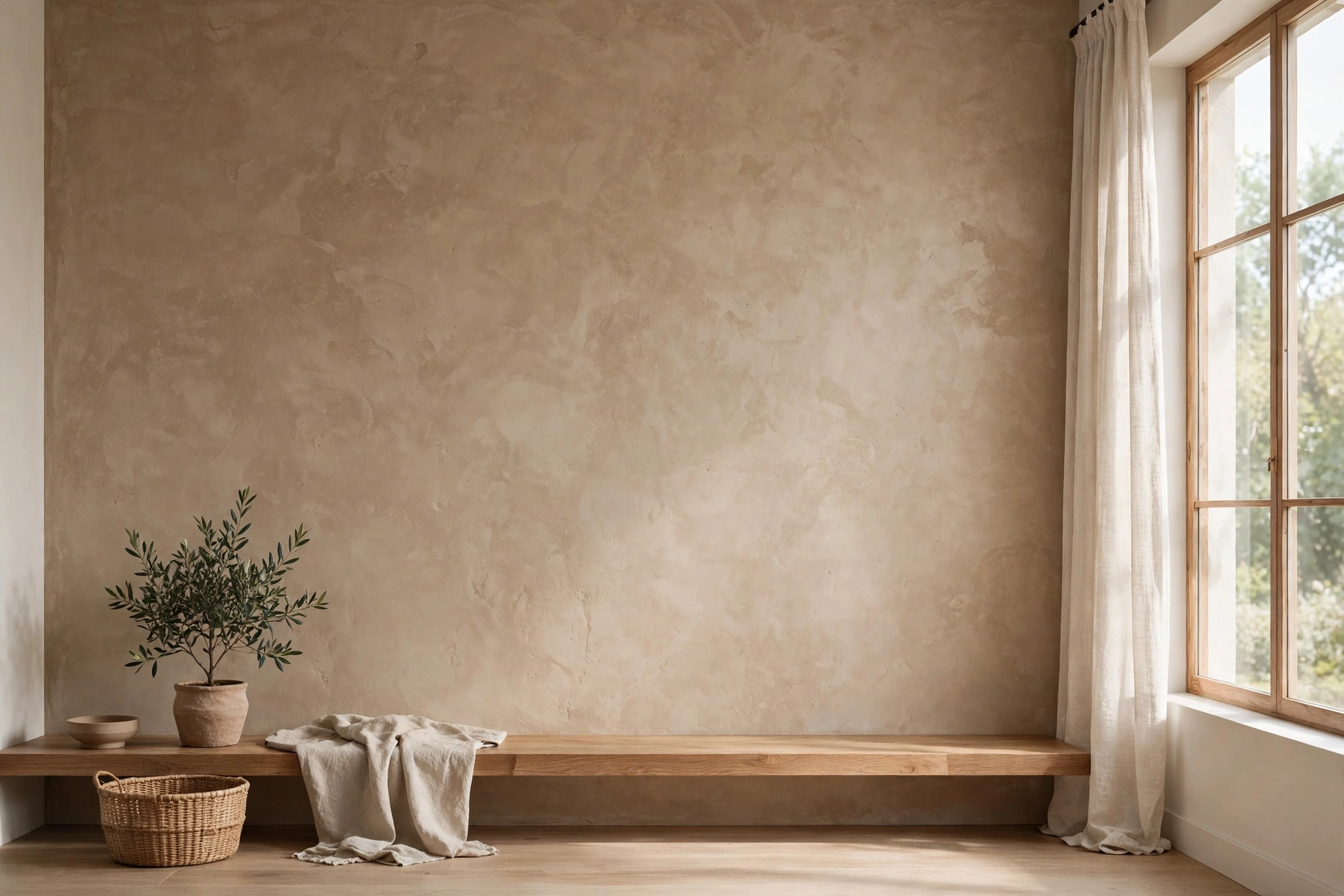
Clay plaster is unfired earth, usually a mix of clay, sand, and fibre, applied to walls in layers and finished without paint or with a vapour-open clay paint. Its buffering strength comes from the clay minerals themselves, which adsorb water vapour onto their enormous internal surface when the air is damp and release it when the air dries. A few centimetres of clay plaster are enough to buffer the daily humidity cycle in a room, and the effect is strongest in rooms where the plaster is exposed over a large area, such as a bedroom or a living room with clay on two or three walls.
Lime, Gypsum and Wood Fibre Compared
Lime plaster is the traditional alternative to clay, and it buffers well while also resisting mould, because its high alkalinity discourages fungal growth. It is slower to apply and slower to cure than clay, and it needs a skilled hand, but it suits damp-prone rooms and historic buildings particularly well. Gypsum plaster buffers moderately and is the easiest of the three to apply, but its capacity is lower than clay or lime, and it should not be used where it will stay damp. Wood fibre boards, used as an internal lining or as insulation, buffer strongly and also insulate, which makes them a good choice where a wall needs both moisture regulation and thermal improvement.
| Material | Buffering strength | Best use and cautions |
|---|---|---|
| Clay plaster | Very high, the benchmark | Bedrooms and living rooms; keep dry, use vapour-open finish |
| Lime plaster | High, plus mould resistance | Damp-prone rooms and historic walls; needs skilled application |
| Gypsum plaster | Moderate | General rooms; avoid places that stay damp |
| Wood fibre boards | High, plus insulation | Internal lining where insulation and buffering are both wanted |
| Cellular concrete | Very high | Exposed internal blockwork; needs a breathable finish |
| Unfired clay brick | Very high | Feature walls and thermal mass; protect from direct water |
How Much Buffering Surface Does a Room Need
Buffering is a matter of area as much as material, because a small patch of clay plaster cannot steady the humidity of a whole room. As a rule of thumb, the exposed buffering surface should cover a large fraction of the room’s wall area, ideally two or more walls, and the ceiling can contribute too if it is finished in a hygroscopic material. A single feature wall will help, but the effect grows with area, and a room with clay plaster on every wall will hold its humidity far steadier than a room with one clay wall and three painted ones.
- Aim for buffering material on at least two walls of a bedroom or living room, not just one feature wall.
- Include the ceiling where possible, because it is a large surface that is rarely used for anything else.
- Keep the surface exposed, because furniture, pictures, and curtains all reduce the area in contact with room air.
- Avoid vapour-closed paints and wallpapers over buffering materials, or the buffer is sealed off.
- Count the area honestly: a wall behind a wardrobe does not buffer, because the air cannot reach it.
Depth matters too, but less than most people think. A few centimetres of clay plaster are sufficient to buffer the daily cycle, because only the outer layer of the material responds to a daily swing. A much greater depth, on the order of forty centimetres of wall, is needed to buffer the annual cycle, which is why thick earth and masonry walls feel so stable across the seasons. For a retrofit, a normal plaster thickness of 15 to 25 millimetres over a large area is the practical target, and it is enough to take the worst peaks off the daily humidity curve.
Pairing Buffer Materials With Natural Ventilation
Buffering materials and natural ventilation are partners, not alternatives, and they work best when they are planned together. The buffer smooths the daily peaks, but it cannot remove moisture from the house; only ventilation does that. A home that is ventilated at less than about one air change per hour gets the most benefit from buffering, because the air stays in contact with the walls long enough for the material to adsorb and release moisture. A home that is ventilated far more aggressively, with windows open all day, gets less benefit, because the air changes before the walls can act on it.
Applying Clay and Lime Plaster Without Trapping Moisture
Applying a buffering plaster is straightforward, but a few rules decide whether it works. The wall beneath must be sound and dry, and any salt or damp problem in the masonry must be fixed first, because a buffering plaster will not cure a damp wall and will suffer if it is asked to. Clay plaster goes on in two or three coats, each allowed to dry before the next, and it should be protected from frost and from drying too fast, which can cause cracking. Lime plaster is applied similarly but cures by absorbing carbon dioxide from the air, so it needs time and good ventilation during curing, and it should not be forced dry with heaters.
- Fix any damp or salt problem in the wall before plastering, because the plaster cannot cure a wet wall.
- Apply clay plaster in two or three coats, letting each coat dry before the next goes on.
- Protect fresh plaster from frost and from rapid drying, both of which cause cracking.
- Finish with a vapour-open clay or lime paint, never with vinyl paint or a sealed wallpaper.
- Allow lime plaster time to cure by absorbing carbon dioxide, and do not force-dry it with heaters.
The finish is where most buffering projects fail, because it is tempting to paint a clay wall with an ordinary emulsion to get a familiar colour. Ordinary vinyl paint forms a vapour-closed film that seals the plaster surface, and the buffering effect disappears overnight. Use a clay paint, a limewash, or a silicate paint, all of which remain vapour-open and let moisture pass through to the plaster beneath. The colour range of clay paints is wide, and a limewash can be tinted to almost any shade, so there is no need to sacrifice appearance for performance.
Wood, Cork and Other Hygroscopic Finishes
Wood is the most familiar hygroscopic material in a home, and it buffers best when it is used in a form that exposes a large area to the room air. Timber panelling, a wood ceiling, or an exposed timber floor all contribute, and wood cut across the grain buffers particularly well, because the end grain exposes the cell structure that adsorbs moisture. A room with a timber ceiling and clay plaster walls is a strongly buffered room, and the combination is also warm and pleasant to live in. Keep wood finishes vapour-open with oil or wax rather than a sealed varnish, because a sealed surface cannot exchange moisture with the air.
Measuring the Effect and Knowing It Works
Buffering is easy to feel but worth measuring, because a measurement proves the investment and guides the next step. A simple hygrometer in the room, costing very little, will show the daily humidity curve, and a room with good buffering will show a flatter curve than a room without it: lower peaks after cooking and showering, and higher troughs during the day. Log the readings for a week before the work and a week after, and the difference will be visible. For a more formal measure, the NORDTEST protocol is the standard laboratory method for rating moisture buffering, and it gives a moisture buffer value that can be compared between materials.
| Check | What it tells you | When to do it |
|---|---|---|
| Hygrometer log, one week | Daily humidity peaks and troughs | Before and after the work |
| Condensation check | Whether cold surfaces still stream | On cold mornings through winter |
| Paint and plaster condition | Whether damp and mould have reduced | Each season for the first year |
| NORDTEST moisture buffer value | Laboratory rating of the material | When comparing products before buying |
| Ventilation rate check | Whether air changes suit the buffer | After any change to windows or vents |
Indoor Humidity Buffering FAQs: Materials, Ventilation and Mould
Can clay plaster really control humidity without a machine?
It can smooth the daily cycle noticeably, but it cannot replace ventilation. Clay plaster adsorbs moisture when the air is damp and releases it when the air dries, which lowers the peaks after cooking and showering. The moisture still has to leave the house through ventilation, so the buffer works best in a home ventilated at less than about one air change per hour, where the air stays in contact with the walls long enough for the material to act.
Will buffering materials cause mould?
No, when they are used correctly, because they keep the surface humidity steadier rather than letting it sit high for hours. Lime plaster actively resists mould through its alkalinity, and clay plaster dries out again as the room air dries. Mould appears when a surface stays damp for long periods, which is a ventilation or leak problem, not a buffering problem, so fix the moisture source first and let the buffer handle the daily cycle.
How much wall area needs buffering material?
Aim for at least two walls of a bedroom or living room, and include the ceiling where possible, because the effect grows with exposed area. A single feature wall will help, but a room with clay plaster on every wall will hold its humidity far steadier. A few centimetres of plaster thickness is enough for the daily cycle, and the surface must stay exposed, because furniture and vapour-closed paint both reduce the area in contact with room air.
Can I paint over clay or lime plaster?
Yes, but only with a vapour-open finish such as clay paint, limewash, or silicate paint. Ordinary vinyl emulsion forms a sealed film that stops moisture reaching the plaster, and the buffering effect disappears. Clay paints come in a wide colour range and limewash can be tinted, so there is no need to sacrifice appearance for performance.
Do buffering materials work in a mechanically ventilated home?
They help, but the effect is smaller, because a high air change rate replaces the room air before the walls can act on it. Buffering is most valuable in naturally ventilated homes, where the air changes slowly and the walls have time to adsorb and release moisture. In a mechanically ventilated home the ventilation system does most of the work, and the buffer becomes a useful supplement rather than the main control.
Final Thoughts on Humidity Buffering Materials That Steady the Indoor Climate
Humidity buffering materials are a quiet, passive way to make a naturally ventilated home more comfortable. Clay plaster on the bedroom walls, lime plaster in the damp-prone rooms, and timber or cork where they suit the design together steady the daily humidity cycle, reduce condensation, and make the house feel more settled, with no energy use and no machine to maintain. The work is simple, the materials are natural, and the effect is felt within days of the plaster drying.
Start with one room and measure the difference. Put a hygrometer in the bedroom, log a week of readings, then plaster two walls in clay and log another week. When the peaks flatten and the mornings feel drier, the case for the next room makes itself, and the house will gradually become the steady, comfortable place it was always meant to be.